
Showing posts with label CED. Show all posts
Showing posts with label CED. Show all posts
Friday, September 12, 2008
planting templates
how to effectively restore native vegetation is something of an open ended question at this point. it is difficult to measure success, especially when the initial goal is unclear. when you add the complexity of volunteer planting, native stock availability, and both micro and mega fauna, what does it mean to plant a native dune riparian community? my professor Joe McBride has suggested the idea of a "planting template." this is the smallest structural and species-ratio balanced unit that can be repeated (flipping and rotating are key) to achieve the highest likelihood of a long-term native plant community in the targeted area.


Thursday, May 22, 2008
class is out!

welcome back everybody, it's been a while, but it sure is good to see all your friendly faces smiling around our little campfire. ah. smell that sagebrush? hear that coyote? what a world friends! what a world!
a few updates:
they got the raccoon!
"RE: Dead Raccoon
Thanks, we'll get it. "
jacob perkins & the nobody are on tour
i'd recommend the takilma show if you can make it
i rode through the posey tube today. (following excerpt from a gchat conversation)
"the bike path was exactly as wide as one bicycle. on the left was a rusty handrail, then a 6ft drop to the crowded busy freeway. on the right was a dirty white tile wall that curved up over me to form the top of the tube. if i deviated just the slightest fraction i would hit either the wall or the handrail. the tube is 3545ft long. dark & dirty. the fumes were so thick and acrid that my eyes were burning the whole way and i choked as i pedaled up the slight slope. the sound in the tunnel was a huge roar with intermittent honks. big trucks passed just feet from me, but i was oddly above the cars, looking down on them. there was a pedestrian walking in the opposite direction and he literally had to climb up on the handrail and i had to brush against the white tile to make it past each other. i almost had a panic attack."
they also found out that 1km below the ocean floor there are organisms that may be 111million years old. and that 85% of snowflakes form around bacteria.
here's an idea...
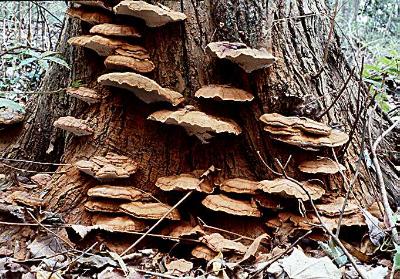
some bracket fungus species exhibit nondeterministic growth, i.e. they're able to alter their growth habits, size, and form in response to environmental variables. these conk fungi have hard, wood-like fruiting bodies that are tough and durable. i suggest that bio-engineered fungus of this type may be able to provide shelter, furniture, and entire houses. a hybridized, gen-mod spore could be cultured on any bio-waste stream and assume the programmed form. grow a wall, a roof, a chair, a table. when the useful lifespan of that object had come to and end, the mushroom would produce spores, which could be harvested and taken to the next domicile or homesite, where the process could begin again. the old conk would simple decompose.


Sunday, April 27, 2008
Mushrooms to clean up dioxin in Fort Bragg California
I am a huge proponent of myco-remediation and I often incorporate a bio-remediation stage in site development proposals. That's why I was just tickled pink to read this article in the NYTIMES today.
http://www.nytimes.com/2008/04/27/us/27bragg.html
The legacy of the large timber industry that once owned northern California is large tracts of contaminated land where their mills once stood. In the case of Fort Bragg the municipality was given rights to a 420 acre strip of seashore land that came with a typical toxic-soils caveat... they could have the land only if they dealt with the contamination, specifically five hot-spots that had high levels of dioxin. the options tabled to deal with the soil were either to haul the dirt away, or bury it in a lined landfill on site.
but then they contacted Paul Stamets, mushroom-guru cum-savvy eco-business warrior, and he suggested turkey tail & oyster mushrooms (medicinal tea & stir-frys, respectively). Dioxin (C4H4O2) is an organic molecule with no heavy metals or radioactive isotopes, and as such it's ripe fodder for the tenacious mushroom mycelium that can break apart the chemical bonds and convert the basic atomic building blocks of carbon and hydrogen into rich mushroom proteins & sugars.
The Fort Bragg community voiced their support and were given a few yards of dioxin contaminated soil & facilities to conduct a myco-remediation experiment. It might be some years before we know for sure how well this works, but it's hopeful to see otherwise dangerous contaminants being turned not only into benign substances but straight into medicine and food.
For those who missed it, the recent San Francisco oil spill, resulting from an inebriated bar pilot slamming a tanker into the footing of the Bay Bridge, was cleaned up using mats made of human hair donated by the city's stylists and barbers. The mats were then hauled off and DIGESTED... oil & all, by oyster mushrooms, also provided by Paul Stamets.
http://www.sfgate.com/cgi-bin/article.cgi?f=/c/a/2007/11/14/MNPQTBLE4.DTL
and finally here's the first board from my final project last year where I proposed deconstructing the 101 Freeway in the Presidio and digesting the asphalt using mushrooms.

http://www.nytimes.com/2008/04/27/us/27bragg.html
The legacy of the large timber industry that once owned northern California is large tracts of contaminated land where their mills once stood. In the case of Fort Bragg the municipality was given rights to a 420 acre strip of seashore land that came with a typical toxic-soils caveat... they could have the land only if they dealt with the contamination, specifically five hot-spots that had high levels of dioxin. the options tabled to deal with the soil were either to haul the dirt away, or bury it in a lined landfill on site.
but then they contacted Paul Stamets, mushroom-guru cum-savvy eco-business warrior, and he suggested turkey tail & oyster mushrooms (medicinal tea & stir-frys, respectively). Dioxin (C4H4O2) is an organic molecule with no heavy metals or radioactive isotopes, and as such it's ripe fodder for the tenacious mushroom mycelium that can break apart the chemical bonds and convert the basic atomic building blocks of carbon and hydrogen into rich mushroom proteins & sugars.
The Fort Bragg community voiced their support and were given a few yards of dioxin contaminated soil & facilities to conduct a myco-remediation experiment. It might be some years before we know for sure how well this works, but it's hopeful to see otherwise dangerous contaminants being turned not only into benign substances but straight into medicine and food.
For those who missed it, the recent San Francisco oil spill, resulting from an inebriated bar pilot slamming a tanker into the footing of the Bay Bridge, was cleaned up using mats made of human hair donated by the city's stylists and barbers. The mats were then hauled off and DIGESTED... oil & all, by oyster mushrooms, also provided by Paul Stamets.
http://www.sfgate.com/cgi-bin/article.cgi?f=/c/a/2007/11/14/MNPQTBLE4.DTL
and finally here's the first board from my final project last year where I proposed deconstructing the 101 Freeway in the Presidio and digesting the asphalt using mushrooms.

Subscribe to:
Posts (Atom)

 Posts
Posts


