Showing posts with label mushrooms. Show all posts

Friday, August 22, 2008

Mushrom Log Cultivation


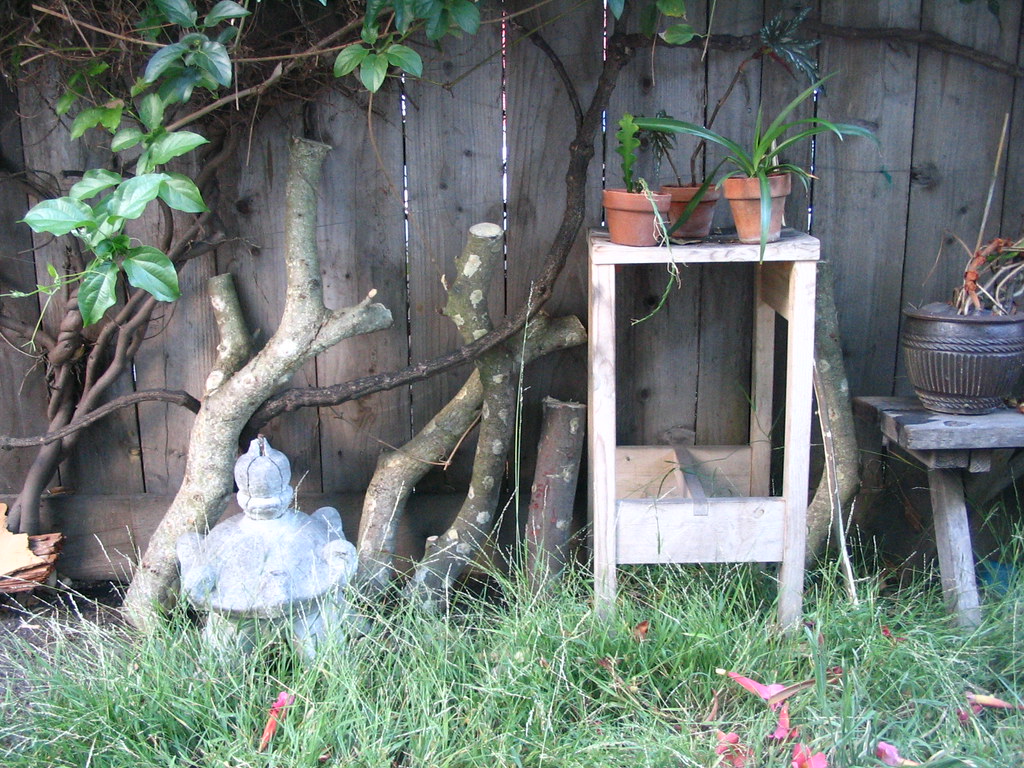
so a month ago my friend Alex and i got together and hammered some innoculated plug spawn into some oak limbs that I had picked up from Blake Garden. she had oyster, shitake, and reishi mushrooms, and we inoculated about four lengths of oak with each variety by drilling holes (up to 50/log) and then gently pounding in the myceliated dowels.


we melted some wax and sealed the holes and then divided the spoils. i've been watering them every week or so and they're in a very shady part of the yard. in 7-9mos I'll take the logs and soak them for a few days in a tub of water, initiating a flush. hopefully. so check back in 9mos.

maybe this?

Sunday, April 27, 2008

Mushrooms to clean up dioxin in Fort Bragg California

I am a huge proponent of myco-remediation and I often incorporate a bio-remediation stage in site development proposals. That's why I was just tickled pink to read this article in the NYTIMES today.

http://www.nytimes.com/2008/04/27/us/27bragg.html

The legacy of the large timber industry that once owned northern California is large tracts of contaminated land where their mills once stood. In the case of Fort Bragg the municipality was given rights to a 420 acre strip of seashore land that came with a typical toxic-soils caveat... they could have the land only if they dealt with the contamination, specifically five hot-spots that had high levels of dioxin. the options tabled to deal with the soil were either to haul the dirt away, or bury it in a lined landfill on site.

but then they contacted Paul Stamets, mushroom-guru cum-savvy eco-business warrior, and he suggested turkey tail & oyster mushrooms (medicinal tea & stir-frys, respectively). Dioxin (C
4H4O2) is an organic molecule with no heavy metals or radioactive isotopes, and as such it's ripe fodder for the tenacious mushroom mycelium that can break apart the chemical bonds and convert the basic atomic building blocks of carbon and hydrogen into rich mushroom proteins & sugars.

The Fort Bragg community voiced their support and were given a few yards of dioxin contaminated soil & facilities to conduct a myco-remediation experiment. It might be some years before we know for sure how well this works, but it's hopeful to see otherwise dangerous contaminants being turned not only into benign substances but straight into medicine and food.

For those who missed it, the recent San Francisco oil spill, resulting from an inebriated bar pilot slamming a tanker into the footing of the Bay Bridge, was cleaned up using mats made of human hair donated by the city's stylists and barbers. The mats were then hauled off and DIGESTED... oil & all, by oyster mushrooms, also provided by Paul Stamets.

http://www.sfgate.com/cgi-bin/article.cgi?f=/c/a/2007/11/14/MNPQTBLE4.DTL

and finally here's the first board from my final project last year where I proposed deconstructing the 101 Freeway in the Presidio and digesting the asphalt using mushrooms.

Tuesday, April 1, 2008

fungus among us


As the planet continues to experience rapid climate change due to human actions, the potential impact on the microbiotic community is little understood. Despite the overwhelming diversity, biomass, and ecological importance of bacteria, archaebacteria, and fungus we spend very little time worrying about their long-term stability... except when they start killing bigger things.

two cases in particular. the frogs of central & south america, and the oaks of northern california. both are being laid low by a fungus. in the case of the frogs it is a chytrid fungus, Batrachochytrium dendrobatidis, the oaks Phytothphora ramorum, an oomycete.


P. ramorum (oak killer) was first reported in 1995 along the hills of the northern California coast, where it rapidly began infecting large populations of the coastal live oak and black oak, once infected mortality is assured. Oozing black cankerous sores, wilting leaves, beetle infestations, and then death mark the disease. In Europe a similar afflication was identified as being P. ramorum shortly after it was found in the U.S. The fungus also infects many different host tree species, such as rhododendrons, but does not cause mortality, using the host instead as a spore factory that can spread the fungus via water or wind to new oaks. The origin of P. ramorum is not understood.

B. dendrobatidis (frog killer), on the other hand is a well known disease of amphibians but usually only effects a small percentage of any given community. However, during the 1980's and 1990's two thirds of the 110 harlequin frog species vanished, even those in remote mountainous areas, driven extinct by the fungus. The scientists were stumped until long-term climate data was analyzed for the cloudy rainforests where the frogs live. They realized that due to global warming the forests weren't getting as cold during the night, but were getting cooler during the day, constricting the temperature range. Without the extreme temperatures to limit it, B. dendrobatidis flourished, the infection rates in the frogs bounded upward, and species began dying off.

I believe that a similar process is at work in the oak death, a climate threshold was crossed and the California coast became a more suitable habitat for P. ramorum, perhaps latent in host species it proliferated and began attacking the oaks. As global climate changes we would expect to see corresponding shifts in the microbiota as the new conditions favor a different set of species that come into the population forefront while others step back or go extinct.

Temperatures continue to creep higher, and there is no telling what kind of organism may begin multiplying into the warm, moist air or water. The frogs and the oaks are obvious examples, but other inexplicable die-offs may be related. the Colony Collapse Disorder afflicted honeybees were full of fungus, bacteria, and viruses. More recently the sudden decimation of the bat populations in the eastern U.S. was marked by a white fungus that grew on the bat's noses just before death.

Two points make a line, three a plane, and a pattern emerges. While the polar bears stuck on ice flows get the press the real consequences of climate change may be more subtle, yet much deadlier. if you're interested in purchasing a fungal spore-proof respirator visit the merchandise area of my blog-world. best of luck buddies!

http://www.newscientist.com/article.ns?id=dn8569

http://news.nationalgeographic.com/news/2006/01/0112_060112_frog_climate.html

http://en.wikipedia.org/wiki/Sudden_oak_death


http://www.nytimes.com/2008/03/25/science/25bats.html

http://en.wikipedia.org/wiki/Colony_collapse_disorder